Technology Deep Dive

Inside the Coherent Lab: Beam, Pulse, Spectrum & Safety

A technical anatomy of the four engineering blocks that define a Coherent-grade laser source — fiber architecture, ultrafast pulse shaping, beam combining, and CDRH-compliant safety engineering.

01 · Fiber Architecture

HighLight DF & FL-ARM — Two Fiber Platforms, One Engineering Core

HighLight DF fiber delivers a single-mode or multi-mode output from a common resonator platform — integrators pick core diameter and delivery fiber without changing the pump diode architecture. FL-ARM builds on the same core but adds adjustable ring-mode optics: independent control over central and ring power, inside one output head.

Practical consequence: an FL-ARM 6 kW module can weld 200 µm copper foil at 180 mm/s with spatter below 1.1 mg/m, then reconfigure on-the-fly for 2 mm aluminum conduction welding — without swapping hardware.

  • Single-mode precision branch — M² < 1.1, 50 µm delivery fiber
  • Multi-mode high-power branch — 100 / 200 µm delivery, up to 30 kW class
  • FL-ARM ring-mode — independent central / ring power, > 10 kHz switching
  • Wavelength 1064 / 1080 nm with power stability ±0.8% over 24-hour windows
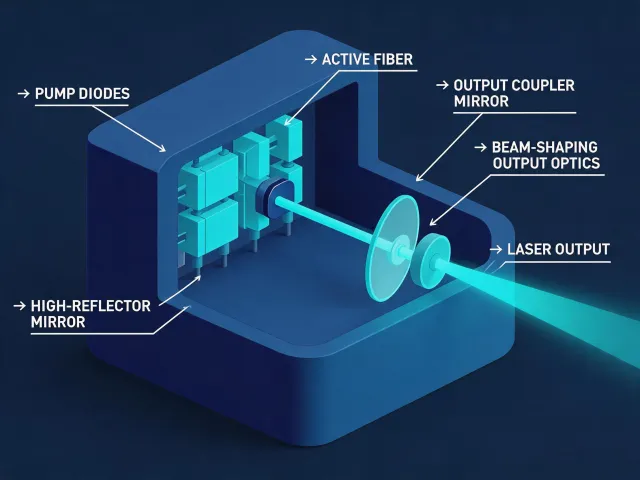
HighLight and FL-ARM fiber laser architecture schematic
02 · Ultrafast Pulse Engineering

Monaco & Chameleon — From Femtosecond Physics to Factory Floor

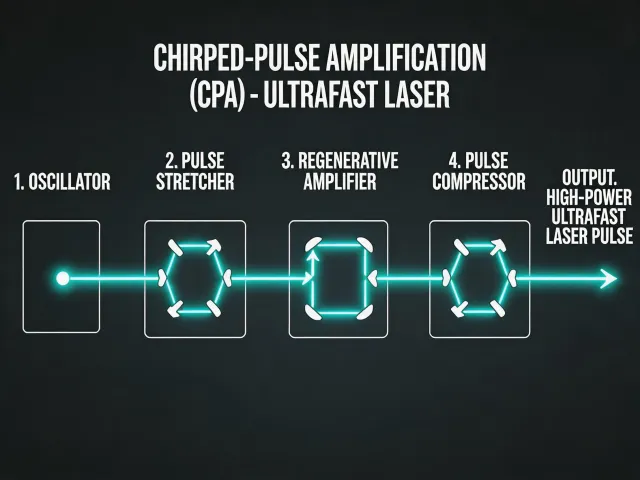
Monaco industrial ultrafast sources deliver pulse durations from 250 fs up to 10 ps, tunable per application, at repetition rates extending from single-shot to 1 MHz. The same chirped-pulse amplification engineering that powers Nobel-class physics laboratories is productized into rack-mounted, 24/7-qualified modules.

Chameleon Ti:Sapphire adds tunable wavelength (680 – 1080 nm) for multiphoton microscopy, pump-probe spectroscopy and non-linear biophotonics — built in Coherent's Santa Clara scientific-lasers center with full pulse-characterization instruments on every serial.

  • Monaco — 250 fs – 10 ps tunable, 60 W avg, 40 µJ energy, 1 MHz repetition
  • Chameleon Ultra II — 680 – 1080 nm tuning, < 140 fs, automated wavelength scanning
  • Pulse duration characterization on every serial — FROG / autocorrelator log in the dossier
  • Burst-mode and pulse-on-demand triggering available for precision dicing
Monaco ultrafast chirped-pulse amplifier schematic
03 · Beam Combining

Spectral & Coherent Beam Combining — Brightness Beyond One Fiber

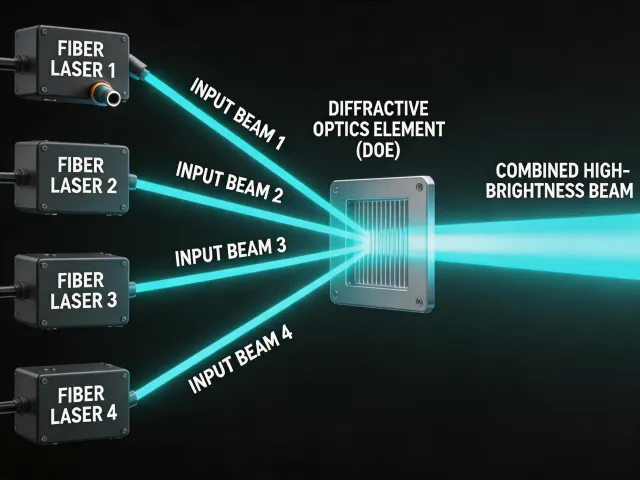
Spectral beam combining (SBC) uses a diffractive element to superimpose beams from N fiber sources, each at a slightly different wavelength, into a single high-brightness output. Coherent beam combining (CBC) goes further — phase-locks N fiber channels so their electric fields add coherently, scaling brightness with N rather than just power with N.

Coherent's SBC and CBC platforms take a research-grade capability — historically confined to national-lab experiments — and productize it for directed-energy research, next-generation industrial cutting and advanced welding applications where a single-fiber brightness wall had previously blocked progress.

  • SBC arrays up to 10 kW combined brightness from commercial fiber modules
  • CBC prototypes with phase-locked channel counts for directed-energy R&D contracts
  • Diffractive combiner optics engineered in-house at the Coherent optics center
  • Closed-loop phase control for adaptive beam steering in atmospheric paths
Spectral and coherent beam combining optical schematic
04 · Safety Engineering

CDRH / IEC 60825-1 / ANSI Z136 — Built Into the Source, Not Bolted On

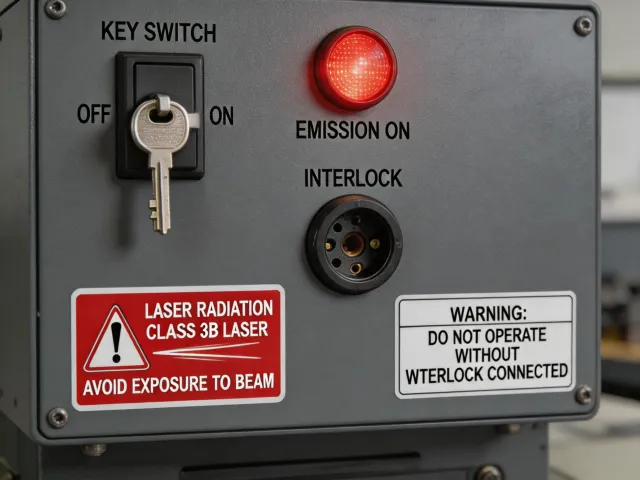
Every Coherent industrial fiber and ultrafast source ships as a Class 4 laser product under 21 CFR 1040.10 with a Laser Safety Manual, serial-specific label, remote interlock connector, key-switch and emission indicator. The CDRH file supports OEM integrators with pre-prepared documentation for their end-product accession.

Coherent sources are engineered to support integrators building IEC 60825-1-compliant enclosures — beam-stop interlocks, dual-channel emission monitoring and audit-trail firmware logging of every emission window. Safety is an engineering discipline, not a compliance afterthought.

  • 21 CFR 1040.10 Class 4 accession maintained continuously with the U.S. FDA CDRH
  • IEC 60825-1:2014 classified with accredited third-party test-house reports on file
  • ANSI Z136.1 — in-house laser safety officer team supports integrator compliance programs
  • Dual-channel interlock and emission-log firmware for integrator-side audit requirements
Laser safety engineering cabinet with interlock and emission indicator
Platform Matrix

Characteristic Operating Ranges Across the Portfolio

Characteristic values drawn from published Coherent datasheets. Actual deliverables depend on platform configuration — the characterization dossier supplies guaranteed numbers per serial.

Platform Wavelength Power / Energy Pulse Regime Beam Quality (M²)
HighLight DF (single-mode) 1064 nm 1 – 6 kW CW CW / modulated < 1.1
HighLight DF (multi-mode) 1064 nm 6 – 30 kW CW CW / modulated < 3.5
FL-ARM Ring-Mode 1080 nm 3 – 12 kW CW CW / modulated core + ring < 2.0 (core)
Monaco Femtosecond 1035 nm 60 W avg / 40 µJ 250 fs – 10 ps < 1.3
Verdi DPSS 532 nm 2 – 18 W CW CW < 1.1 TEM00
Lambda Physik Excimer 193 / 248 / 308 nm 600 – 1200 W avg Pulsed (ns) Multi-mode line beam
Need a Specific Operating Point?

Request a Serial-Level Characterization Dossier.

Includes full beam-quality curve, spectral figure, pulse-energy envelope (where applicable), power-stability plot and the applications-lab procedure that produced each measurement.